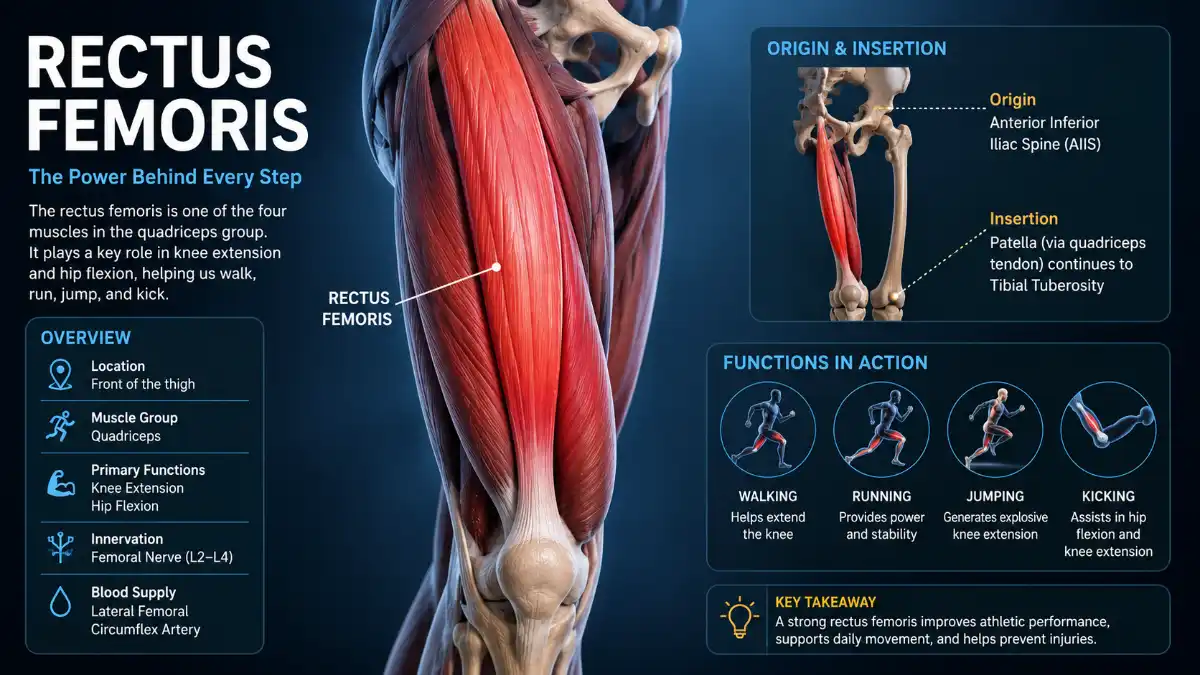
The rectus femoris often goes unnoticed until it starts to hurt-usually after a sprint, a hard kick, or an awkward lunge. As the only muscle in the quadriceps group that crosses both the hip and the knee, it plays a uniquely demanding role in everyday movement and athletic performance, which also makes it uniquely prone to strain.
This guide breaks down what the rectus femoris is, how it works, why it gets injured, and how to treat and strengthen it safely.
What Is the Rectus Femoris?
The rectus femoris is a long, superficial muscle running down the front of the thigh, forming the central and most visible part of the quadriceps group. Unlike its three quadriceps neighbors (vastus lateralis, vastus intermedius, and vastus medialis), it is a two-joint muscle, meaning it acts on both the hip and the knee simultaneously.
This dual action has earned it the nickname the “kicking muscle,” since it powers the two movements needed to deliver a strong kick: hip flexion and knee extension.
Origin and Insertion
The rectus femoris has two points of origin at the hip:
- Direct (straight) head: anterior inferior iliac spine (AIIS)
- Indirect (reflected) head: a groove above the acetabulum (the hip socket ridge)
Both heads merge and travel down the thigh, eventually joining the quadriceps tendon. This tendon inserts into the patella (kneecap) and continues as the patellar ligament, attaching to the tibial tuberosity on the shin bone.
Innervation and Blood Supply
The muscle is innervated by the femoral nerve (branches from the L2–L4 nerve roots). It receives its blood supply primarily from the femoral artery, with additional contributions from the lateral circumflex femoral artery.
What Does the Rectus Femoris Do?
The rectus femoris flexes the hip and extends the knee at the same time, a rare combination among leg muscles that makes it essential for sprinting, kicking, jumping, and climbing stairs.
Because it crosses two joints, its behavior depends heavily on the position of both the hip and knee:
- At the hip: works with the iliopsoas and sartorius to lift the thigh forward (hip flexion)
- At the knee: works with the other three quadriceps muscles to straighten the leg (knee extension)
- During gait: most active during the “toe-off” and “terminal swing” phases of walking or running, when the leg swings forward and prepares to strike the ground.
This two-joint design also means the rectus femoris is subject to active and passive insufficiency-it can’t generate maximum force at the hip and knee simultaneously, which is why exercises that combine deep hip extension with knee flexion (like a rear-leg-elevated lunge) stretch it especially hard.
- Read more: Rectus Femoris
Common Rectus Femoris Injuries
Rectus Femoris Strain
A rectus femoris strain is a tear in the muscle fibers caused by forceful overstretching, most often during explosive activities like sprinting, kicking a ball, or jumping. It’s one of the more common thigh injuries in football, sprinting, and martial arts.
Typical symptoms include:
- Sharp pain in the mid-thigh, sometimes radiating toward the hip
- Pain that worsens with resisted hip flexion or knee extension
- Swelling or bruising in the anterior thigh, depending on severity
- Weakness when trying to kick or sprint
Strains are graded by severity:
| Grade | Description | Typical Recovery Time |
| Grade I | Mild overstretch, minimal fiber tearing | 1–3 weeks |
| Grade II | Partial tear with noticeable strength loss | 4–8 weeks |
| Grade III | Complete rupture, often requiring imaging and specialist care | Several months, sometimes surgical |
Recovery timelines vary by individual and severity, so a healthcare professional’s assessment is the only reliable way to confirm grade and expected timeline.
Rectus Femoris Tendinopathy
Repetitive overuse, common in runners, cyclists, and kicking-sport athletes, can irritate the tendon near its attachment at the AIIS or the patella, leading to chronic anterior thigh or hip pain that builds gradually rather than appearing suddenly like a strain.
Tight Rectus Femoris and Its Downstream Effects
A chronically tight rectus femoris can pull the pelvis into an anterior tilt, which places additional stress on the lower back and knee joints. This is a common contributor to postural discomfort in people who sit for long periods, since prolonged hip flexion shortens the muscle over time.
How Is a Rectus Femoris Strain Treated?
Most rectus femoris strains are treated conservatively using rest, ice, compression, and gradual return tactivity, commonly summarized as RICE.
Initial treatment (first 48–72 hours):
- Rest the muscle and avoid movements that reproduce the pain
- Ice the area for 15–20 minutes every 2–3 hours, always wrapped in a cloth rather than applied directly to the skin
- Compression using an elastic bandage to limit swelling
- Elevation of the leg, when possible,e to reduce fluid buildup
NSAIDs (over-the-counter anti-inflammatory medication) are sometimes used to manage pain and swelling, but should only be taken according to label instructions or a doctor’s guidance, particularly for anyone with existing health conditions.
Once acute pain subsides, gentle stretching and progressive loading help restore flexibility and strength. Grade II and III strains, or any injury accompanied by significant swelling, an inability to bear weight, or a popping sensation at the time of injury, should be evaluated by a doctor or physiotherapist rather than managed at home, since these can indicate more serious tears requiring imaging or specialist treatment.
Best Rectus Femoris Stretches
Stretching the rectus femoris requires combining hip extension with knee flexion, since that’s the fully lengthened position for a two-joint muscle.
Standing quad stretch:
Stand upright, hold onto something for balance, bend one knee, and pull the ankle toward the glutes while tilting the pelvis backward. Push the hips slightly forward to deepen the stretch. Hold for 30 seconds per side.
Kneeling hip flexor stretch:
From a half-kneeling lunge position, rotate the pelvis backward (posterior tilt) and gently push the hips forward. This targets the hip-flexion component of the muscle more directly than a standing stretch. Hold for 30 seconds and repeat 2–3 times per side.
Prone quad stretch:
Lying face-down, bend one knee and reach back to hold the ankle, gently pulling the heel toward the glutes while keeping the hips pressed into the floor. This isolates the knee-flexion portion of the stretch.
Side-lying quad stretch:
Lie on your side, bend the top knee, and pull the ankle back while tucking the tailbone under and pushing the hips forward. Useful for people who find standing balance stretches uncomfortable.
Rectus Femoris Strengthening Exercises
Because the rectus femoris works across two joints, effective strengthening should train both hip flexion and knee extension, ideally together.
- Straight leg raises: build knee-extension strength without loading a bent knee, useful early in rehab.
- Wall slide squats: strengthen the quadriceps group through a controlled range of motion
- Reverse or split lunges: load the rectus femoris in a lengthened position, closely mimicking sprinting mechanics.
- Alternating split-squat jumps: for advanced athletes returning to explosive sports, building power in the stretched position.n
- Standing knee drives or high-knee marches: reinforce the hip-flexion component specific to sprinting and kicking
Progression should move from a controlled, pain-free range of motion to more dynamic, sport-specific movement only once strength and flexibility have been restored. Rushingng back into sprinting or kicking too early is one of the most common causes of re-injury.
Rectus Femoris vs. Other Quadriceps Muscles
| Muscle | Joints Crossed | Primary Action | Common Injury Context |
| Rectus femoris | Hip and knee | Hip flexion + knee extension | Sprinting, kicking, sports |
| Vastus lateralis | Knee only | Knee extension | Cycling and running are overused |
| Vastus medialis | Knee only | Knee extension, patellar stabilization | Post-knee-surgery weakness |
| Vastus intermedius | Knee only | Knee extension | Rarely injured in isolation |
This distinction matters clinically: because the rectus femoris is the only two-joint muscle in the group, it’s disproportionately represented in sports-related thigh strains compared to the other three quadriceps muscles, which are more often involved in overuse patterns.
Frequently Asked Questions
What is the main function of the rectus femoris?
The rectus femoris flexes the hip and extends the knee simultaneously. It’s the only muscle in the quadriceps group that crosses both joints, making it essential for movements like sprinting, kicking, and climbing stairs, where the thigh needs to lift forward while the knee straightens.
Why is the rectus femoris called the kicking muscle?
It’s nicknamed the kicking muscle because a forceful kick requires exactly the two actions it performs together: flexing the hip to swing the leg forward and extending the knee to straighten it explosively. A few other muscles combine both movements in a single contraction.
How long does a rectus femoris strain take to heal?
Recovery depends on strain severity. Mild (Grade I) strains typically improve within 1–3 weeks, moderate (Grade II) strains can take 4–8 weeks, and severe (Grade III) tears may require several months and specialist care. A healthcare provider’s assessment is the most reliable way to estimate an individual’s recovery time.
Can a tight rectus femoris cause lower back pain?
Yes, a chronically tight rectus femoris can tilt the pelvis forward (anterior pelvic tilt), which increases stress on the lumbar spine and may contribute to lower back discomfort. Regular stretching and hip-flexor mobility work can help address this, especially for people who sit for extended periods.
What’s the difference between a quad strain and a rectus femoris strain specifically?
“Quad strain” is a general term covering any of the four quadriceps muscles. A rectus femoris strain specifically refers to damage in the muscle that crosses both the hip and knee, and it typically causes pain in the mid-thigh that worsens with resisted hip flexion, distinguishing it from strains isolated to the vastus muscles, which mainly affect knee extension.
Should I stretch or strengthen a strained rectus femoris first?
In the acute phase (first 48–72 hours), rest and gentle range-of-motion movement are prioritized over aggressive stretching or strengthening. Once acute pain and swelling subside, gradual stretching typically comes first to restore flexibility, followed by progressive strengthening exercises before returning to sprinting, kicking, or jumping activities.
Is it safe to exercise with rectus femoris tendinopathy?
Some controlled loading is often part of tendinopathy rehabilitation, but training through sharp pain or continuing high-impact activity without modification can worsen the condition. Anyone with persistent anterior thigh or hip pain lasting more than a few weeks should get an assessment from a physiotherapist or sports medicine doctor before continuing a training program.