

Ask how many weeks in a year there are, and you may encounter two different answers: 52 and 53.
Both can appear on calendars, but they do not mean the same thing.
In terms of elapsed time, an ordinary 365-day year contains 52 full seven-day weeks plus 1 day. A 366-day leap year contains 52 full weeks plus 2 days.
Yet a standardized week-number calendar can sometimes include a Week 53.
There is no contradiction. The difference comes from comparing calendar-year duration with a week-numbering system.
The Most Important Distinction
There are two separate questions:
Question 1: How many complete seven-day periods fit in a calendar year?
Answer:
52
Because:
52 × 7 = 364 days
A common year then has one day left.
A leap year has two days left.
Question 2: How many numbered ISO weeks can belong to a week-year?
Answer:
52 or 53
Once you understand that distinction, the apparent 52-versus-53 problem disappears.
- Read more: Weeks in a Year
Calendar Year vs Week-Year
A calendar year has familiar boundaries:
January 1 through December 31
A week-year is organized around complete weeks.
Under the widely used ISO system, weeks run from Monday through Sunday.
Because a seven-day week cannot always fit neatly within the January 1-to-December 31 boundary, some days near New Year’s Day may belong to the adjacent ISO week-year.
That is why a week can begin in December but be assigned to the following ISO year—or begin in December and remain part of the previous ISO week-year.
How ISO Week Numbering Works
ISO 8601 provides standardized representations for dates and times.
For ISO week dates:
- Weeks run Monday through Sunday.
- Week-year boundaries do not necessarily match January 1.
- Week 1 is determined by the position of the first day of January.
A commonly used practical description is that Week 1 is the week containing the year’s first Thursday.
Another equivalent way to understand it is that Week 1 is the week containing January 4.
These rules ensure that a numbered week is treated as a complete Monday-to-Sunday period.
Why Week 1 Can Begin in December
Imagine January 1 falls late in a week.
Rather than calling a partial collection of days Week 1 and then beginning Week 2 immediately afterward, ISO assigns complete Monday-to-Sunday weeks.
As a result, ISO Week 1 can begin during the final days of December.
Likewise, the final ISO week of a week-year may extend into the opening days of January.
The week itself remains seven days long.
Only its week-year label differs from the ordinary calendar-year boundary.
When Does an ISO Year Have Week 53?
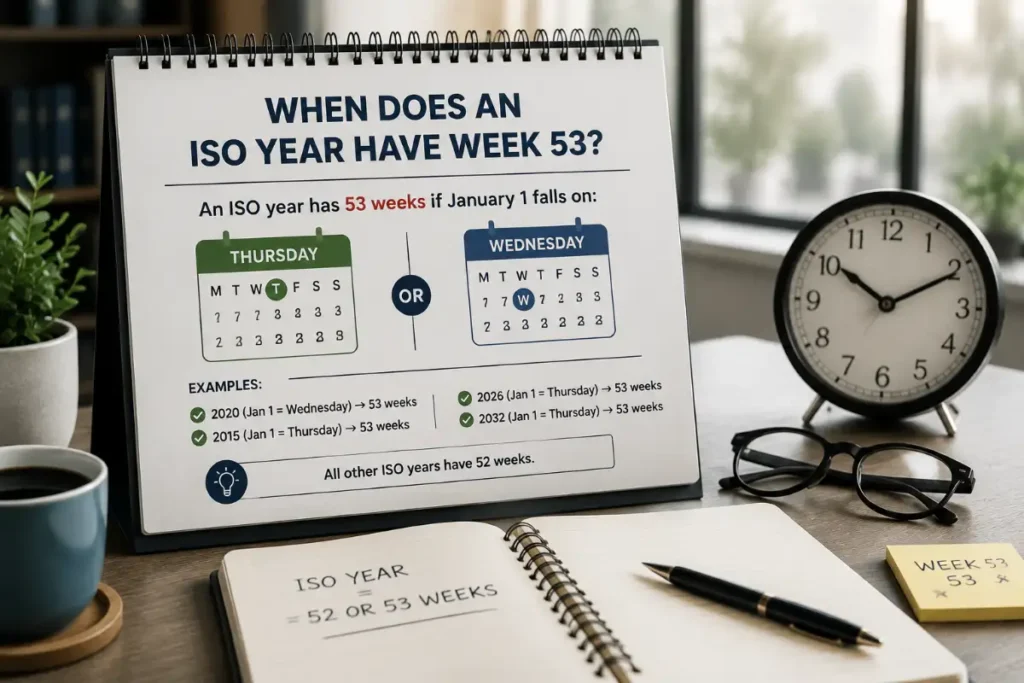
Most ISO week-years contain 52 numbered weeks.
Certain calendar arrangements require a 53rd.
A practical rule is that an ISO year has Week 53 when:
- January 1 falls on a Thursday, or
- a leap year begins on a Wednesday.
The exact result follows from the interaction between the 365- or 366-day year and complete Monday-to-Sunday ISO weeks.
Why 2026 Is a Useful Example
The year 2026 begins on a Thursday.
Therefore, under ISO week numbering, 2026 has a Week 53.
Week 53 of ISO week-year 2026 runs:
Monday, December 28, 2026 through Sunday, January 3, 2027
Look closely at those dates.
Only four of them—December 28, 29, 30, and 31—are inside calendar year 2026.
The remaining three dates occur in January 2027.
Yet the complete week is identified as:
2026-W53
This demonstrates exactly why “53 ISO weeks” does not mean the January-to-December calendar suddenly gained another seven days.
Does 2026 Have 52 Weeks or 53 Weeks?
The best answer depends on what the person means.
By elapsed calendar time:
2026 has 365 days.
That equals:
52 full weeks + 1 day
By ISO week numbering:
2026 has numbered weeks from Week 1 through Week 53.
So if someone asks about year length, use the first answer.
If someone is asking about ISO calendar labels, use the second.
Why 53 × 7 Does Not Work
If 2026 actually contained 53 complete seven-day periods within January 1 through December 31:
53 × 7 = 371 days
But 2026 has only 365 days.
The explanation is that ISO week 53 crosses into 2027.
The week-year and calendar year overlap without sharing identical boundaries.
Common Year vs Leap Year
The Gregorian calendar uses two basic year lengths.
| Year | Days | Full Seven-Day Weeks | Remaining Days |
| Common year | 365 | 52 | 1 |
| Leap year | 366 | 52 | 2 |
Those remaining days gradually change the weekday on which a new year begins.
That shifting pattern is also part of why 53-week ISO years occasionally occur.
Why Does the Calendar Need Leap Years?
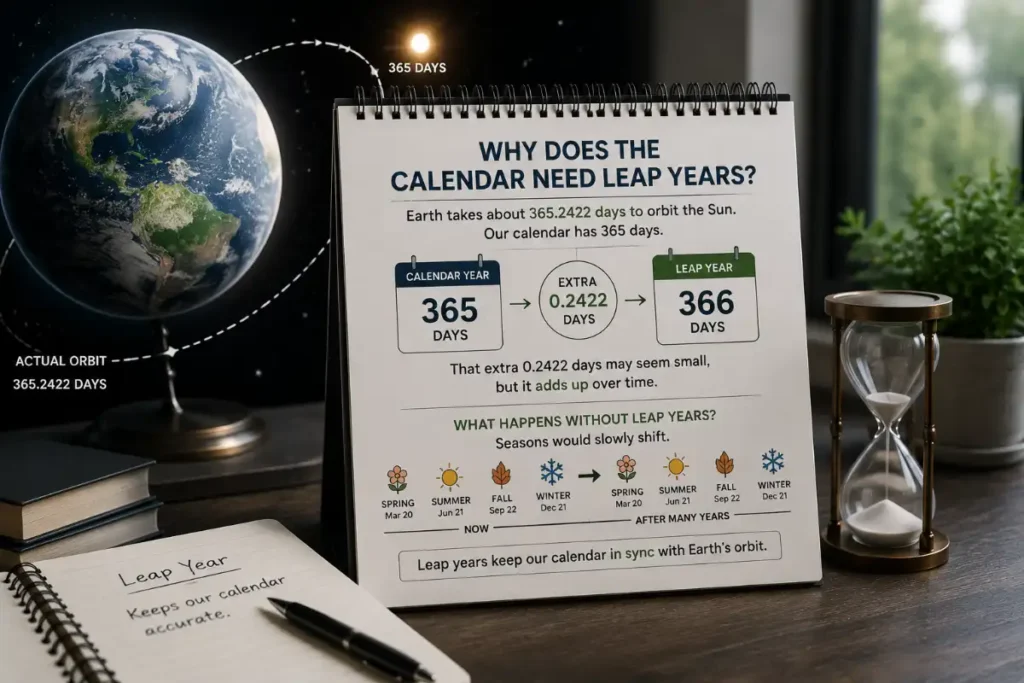
A calendar based on exactly 365 days would gradually drift relative to Earth’s annual cycle.
The Gregorian calendar therefore includes leap years.
Its long-term average year contains 365.2425 days.
The standard leap-year rules are:
- Years divisible by four are normally leap years.
- Years divisible by 100 are not leap years.
- Years divisible by 400 are leap years after all.
Thus:
- 2000 was a leap year.
- 1900 was not.
- 2024 was a leap year.
- 2028 will be a leap year.
Leap-year behavior is important to week calculations because the additional day shifts subsequent weekdays.
Why Different Calendars Can Show Different Week Numbers
ISO 8601 is widely used, but it is not the only week-numbering convention.
Countries, companies, and software systems may differ over:
- Whether a week starts Monday or Sunday
- How Week 1 is determined
- How dates near New Year’s Day are numbered
Therefore, two calendars can occasionally assign different week numbers to the same date.
Neither screenshot should automatically be treated as an error until you know which numbering convention each calendar uses.
ISO Weeks vs Ordinary Calendar Weeks
People use “week” in several ways.
Seven-Day Duration
Seven consecutive days.
Calendar Week
A recurring block such as Sunday–Saturday or Monday–Sunday.
ISO Week
A Monday–Sunday week labeled according to ISO week-year rules.
Workweek
A period defined by an employer or legal/organizational rules.
These definitions overlap but are not interchangeable.
The phrase weeks in a year becomes confusing mainly when people use one definition while assuming another.
What Does 2026-W53 Mean?
ISO dates can represent a week using the year and week number.
For example:
2026-W53
means:
Week 53 of ISO week-year 2026
It is not shorthand for “the 53rd complete seven-day interval contained entirely inside calendar year 2026.”
In 2026, that ISO week runs from December 28 to January 3.
Why Businesses Care About Week Numbers
Week numbers can provide a standardized way to organize recurring operations.
Examples include:
- Production schedules
- Logistics
- Project reporting
- Inventory reviews
- International coordination
- Weekly performance tracking
Instead of saying “the week around December 30,” a system can identify a specific week number.
However, every organization should clearly document the convention it uses.
A company using ISO weeks and another using a Sunday-based numbering system can otherwise appear to disagree even when both calendars are functioning as designed.
Why Software Users Should Check Their Settings
Spreadsheet applications, programming languages, and calendar systems may support more than one way to calculate week numbers.
A user may select or inherit a setting that:
- Starts weeks on Sunday
- Starts weeks on Monday
- Uses ISO week numbers
- Counts the week containing January 1 differently
Consequently, a formula that returns Week 1 in one system may return Week 52 or Week 53 in another near the start or end of a year.
When week numbers affect reporting, document the exact convention rather than assuming everyone uses the same definition.
Why January 1 Isn’t Always in ISO Week 1
This is another surprising consequence of the system.
Because ISO numbering assigns whole Monday-to-Sunday weeks to a week-year, January 1 can sometimes belong to the final week of the previous ISO year.
Similarly, the final days of December can belong to Week 1 of the next ISO year.
This is intentional.
Calendar dates and ISO week dates are two different representations of time.
Is Week 53 an Extra Week?
Not in the sense of adding seven new days to the year.
The calendar still contains the same 365 or 366 dates.
“Week 53” is an additional numbered week label required by that particular week-year arrangement.
A useful analogy is a box crossing a boundary line.
The box remains the same size, but part of it sits on each side of the boundary.
An ISO week near New Year can similarly cross from one calendar year into another.
Exact Weeks vs Decimal Weeks
Another source of confusion is decimal conversion.
A common year gives:
365 ÷ 7 = 52.142857…
A leap year gives:
366 ÷ 7 = 52.285714…
These decimals represent year duration measured in units of seven days.
They are not week numbers.
Similarly, the Gregorian calendar’s average 365.2425-day year equals approximately:
52.1775 weeks
None of these calculations determines whether a particular ISO week-year receives Week 53.
That requires calendar positioning, not merely decimal division.
Which Answer Should a Website Give?
For a broad search like “how many weeks are in a year?”, the clearest answer is:
A common year has 52 full weeks plus one day, while a leap year has 52 full weeks plus two days. Some ISO week-years have a numbered Week 53.
That answer gives users both the familiar result and the exception without creating a false contradiction.
Common 52-vs-53 Week Mistakes

Mistake 1: Saying Every Year Has Exactly 52 Weeks
This ignores the remaining one or two days.
Mistake 2: Saying a 53-Week Year Has 371 Days
A normal calendar year never becomes 371 days merely because its ISO calendar includes Week 53.
Mistake 3: Assuming All Week Numbers Are ISO
Not every calendar application uses the same convention.
Mistake 4: Assuming January 1 Must Be Week 1
Under ISO rules, some early-January dates can belong to the previous ISO week-year.
Mistake 5: Treating a Week-Year as a Calendar Year
Their boundaries can differ.
A Simple Decision Table
| Question | Best Answer |
| How many full weeks fit in 365 days? | 52 + 1 day |
| How many full weeks fit in 366 days? | 52 + 2 days |
| How many weeks should I use for a simple yearly plan? | 52 |
| Can an ISO year have Week 53? | Yes |
| Does Week 53 make the calendar year 371 days? | No |
| Can an ISO week cross New Year’s Day? | Yes |
Frequently Asked Questions
Is a year 52 or 53 weeks?
A calendar year contains 52 complete seven-day weeks plus one or two days. An ISO week-year can contain either 52 or 53 numbered weeks.
Why is there sometimes a Week 53?
The seven-day week does not divide evenly into a 365- or 366-day year. ISO week boundaries sometimes produce a 53rd numbered week.
Does 2026 have 53 weeks?
Under ISO week numbering, yes. ISO Week 53 of 2026 runs from December 28, 2026 through January 3, 2027. In terms of elapsed calendar time, 2026 contains 52 full weeks plus one day.
Is Week 53 seven days long?
Yes. An ISO Week 53 is a normal seven-day Monday-to-Sunday week. It may cross from December into January.
Is there a Week 53 every year?
No. Most ISO week-years have 52 numbered weeks.
Can Week 1 start in December?
Yes. ISO Week 1 can begin during the final days of the preceding December.
Can January 1 belong to the previous ISO year?
Yes. ISO week-year boundaries do not always match calendar-year boundaries.
Why does my calendar show a different week number?
It may use a different week-start day or week-numbering convention. Check whether it uses ISO 8601 week numbering.
How many weeks are in a leap year?
A leap year contains 52 complete weeks plus two days.
How many weeks are in a normal year?
A 365-day common year contains 52 complete weeks plus one day.