
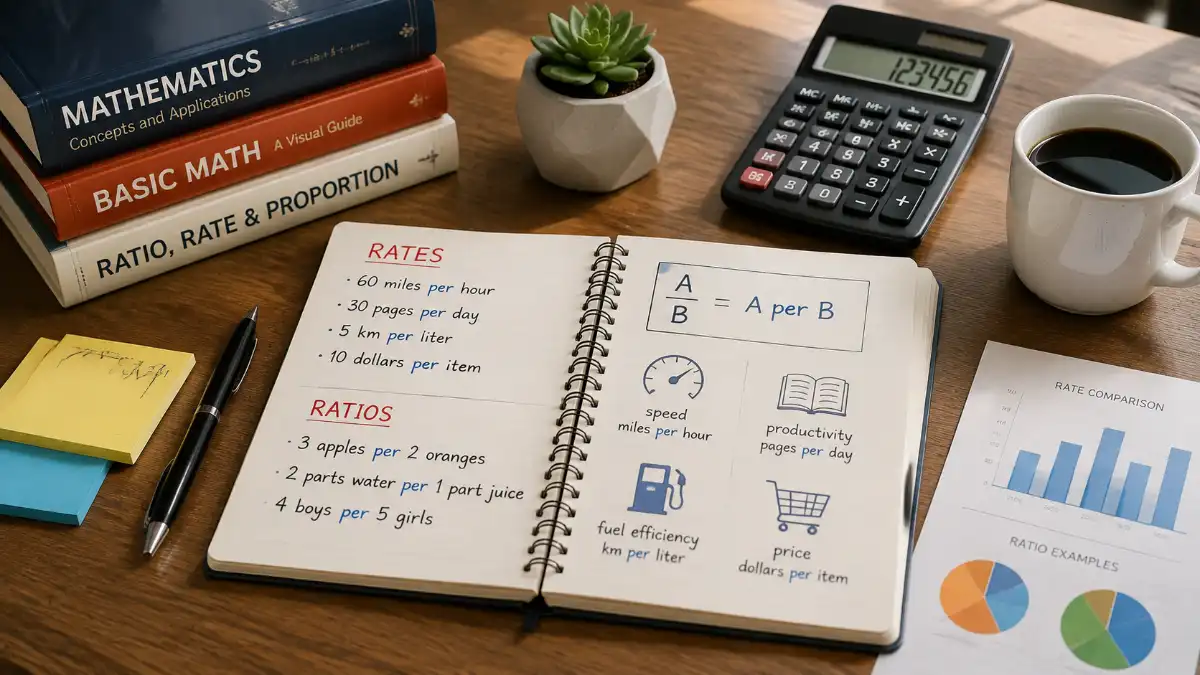
Per in Rates and Ratios: The word per plays an important role whenever English describes rates, ratios, prices, quantities, measurements, and comparisons. It is one of the most useful words for showing how one amount relates to another unit.
You encounter it in expressions such as:
- miles per hour
- price per person
- cost per unit
- calories per serving
- revenue per customer
- visits per month
- sales per employee
- pages per minute
- dollars per day
In many of these expressions, per can be understood as “for each” or “for every.”
For example:
The hotel costs $100 per night.
This means that the stated rate is $100 for each night.
Another example is:
The machine produces 200 units per hour.
Here, the number of units is being compared with one hour.
Understanding this relationship is more useful than simply memorizing a dictionary definition because the same idea appears in mathematics, science, finance, sports, business, travel, shopping, and everyday life.
What Does Per Mean in a Rate?
When per appears in a rate, it usually connects two quantities.
For example:
20 pages per hour.
This connects:
- 20 pages
- one hour
Conceptually, you can think of it as:
20 pages ÷ 1 hour
The first quantity tells you what is being counted or measured.
The unit after per tells you what that quantity is being compared against.
Another example is:
$25 per person.
This connects:
- $25
- one person
So the rate means $25 for each person.
How Per Creates a Rate
A rate compares one quantity with another.
For example:
60 miles per hour.
The two quantities are:
- distance: 60 miles
- time: one hour
This can be represented conceptually as:
60 miles ÷ 1 hour
That is why per is so common in expressions involving:
- speed
- cost
- time
- production
- population
- efficiency
- frequency
- performance
The word gives the reader a basis for comparison.
- Read more: Per in Rates and Ratios
Understanding Per With a Simple Table
| Expression | What It Compares |
| $20 per hour | money and time |
| 60 miles per hour | distance and time |
| 10 sales per employee | sales and workers |
| 300 calories per serving | calories and serving size |
| $25 per person | price and people |
| 40 pages per minute | pages and time |
| 5 defects per batch | defects and production batches |
| $2 per item | price and individual items |
The unit appearing after per tells you what the first quantity is being measured against.
That simple idea makes even complicated-looking rate expressions easier to understand.
Why Per Rates Are Useful
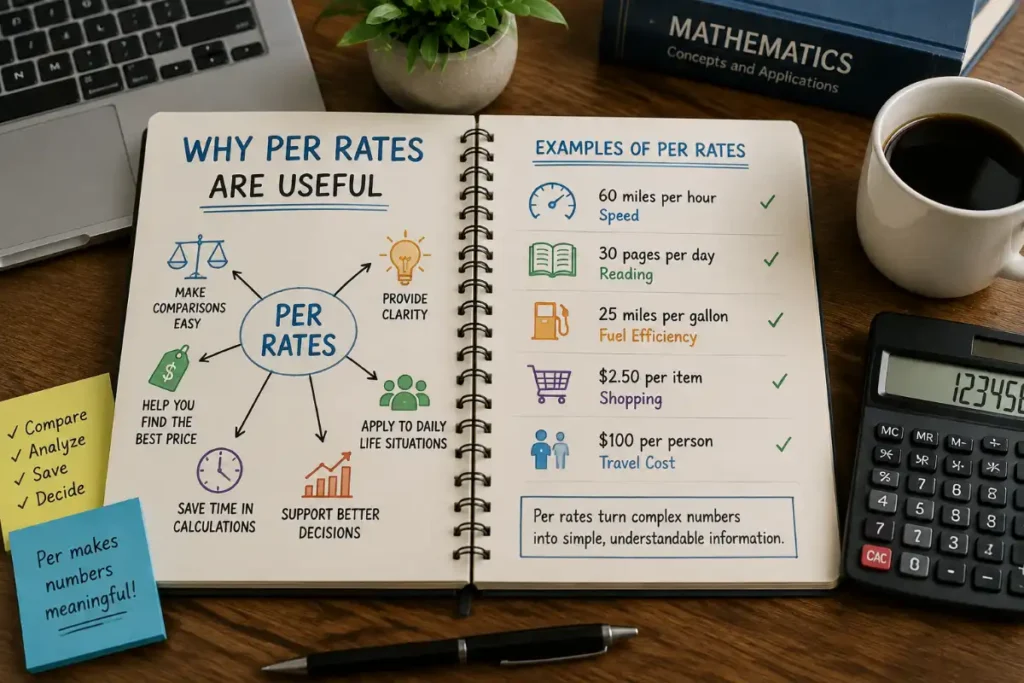
Rates often provide more context than raw totals.
Imagine two stores.
Store A receives 20 customer complaints.
Store B receives 40 customer complaints.
At first, Store B appears worse because it has twice as many complaints.
But suppose:
- Store A serves 200 customers.
- Store B serves 2,000 customers.
Now the picture changes.
Store A has:
20 complaints ÷ 200 customers = 0.10 complaint per customer.
Store B has:
40 complaints ÷ 2,000 customers = 0.02 complaint per customer.
Store B has more complaints in total, but a much lower complaint rate relative to the number of customers.
This example shows why per-customer, per-user, or per-person rates can be more useful than raw totals.
Per Person
Per person means for each person.
Example:
The tour costs $50 per person.
If six people attend:
6 × $50 = $300.
This calculation assumes no additional fees or discounts apply.
“Per person” is commonly used in:
- travel
- restaurants
- tours
- event tickets
- hotel packages
- group activities
- transportation
For example:
Dinner costs $40 per person.
This means each person is charged $40 at the stated rate.
Per Hour
Per hour compares a quantity with one hour.
Common examples include:
- dollars per hour
- miles per hour
- units per hour
- customers per hour
- calls per hour
Example:
The machine produces 100 units per hour.
This means the production rate is 100 units per hour.
Another example:
The employee earns $20 per hour.
This describes the stated hourly pay rate.
Per Minute
Shorter time units are useful when something happens quickly.
Common examples include:
- words per minute
- beats per minute
- pages per minute
- transactions per minute
- rotations per minute
For example:
The printer produces 30 pages per minute.
This compares page output with one minute.
Another example:
The typist averages 60 words per minute.
This tells us the typing rate.
Per Second
Some processes are measured even more quickly.
Examples include:
- meters per second
- frames per second
- requests per second
- transactions per second
For example:
The system processes 500 requests per second.
This is a rate of 500 requests per second.
Per Day
Per day means for each day or at a daily rate.
Examples:
20 orders per day.
$80 per day.
Four appointments per day.
1,000 visitors per day.
One important point is that an average rate does not always mean the same amount happens every day.
Suppose a website averages:
1,000 visitors per day.
One day might have 800 visitors, and another might have 1,200.
The average can still be 1,000 per day over the period being measured.
Per Week
Per week refers to a weekly rate.
Examples:
Three lessons per week.
40 working hours per week.
Two newsletters per week.
Five deliveries per week.
You may also hear:
three lessons a week.
Both forms are common, but per week often sounds more precise in data, policies, reports, or formal communication.
Per Month
Per month describes a monthly rate.
Common uses include:
- subscription pricing
- rent
- memberships
- recurring services
- salaries
- software plans
- reporting
Example:
The plan costs $25 per month.
Another example:
The business gains 500 new customers per month.
This compares the number of new customers each month.
Per Year
Per year means for each year or annually.
Example:
The membership costs $200 per year.
Another example:
The company performs four safety reviews per year.
This establishes an annual rate.
What Does Per Annum Mean?
Per annum means:
for each year
or:
annually
It is more formal than “per year” and frequently appears in:
- financial documents
- contracts
- banking
- salaries
- interest rates
- formal business writing
Example:
The service costs $600 per annum.
The plain-English version is:
The service costs $600 per year.
Both express an annual rate.
What Does Per Diem Mean?
Per diem relates to a daily basis.
Depending on context, it may describe:
- a daily rate
- a daily payment
- a daily allowance
- a daily expense amount
For example:
Employees may receive a per diem while traveling for eligible work.
The exact amount and rules depend on the employer, organization, or policy.
Another use is:
The contractor is paid on a per diem basis.
This indicates a daily payment arrangement.
What Does Per Capita Mean?

Per capita means approximately per person within a population.
It is commonly used when comparing:
- countries
- states
- regions
- cities
- populations
- economic data
- public spending
- consumption
For example, suppose one city has a total income of $100 million, and another has $500 million.
The second city appears richer based on total income.
However, if the first city has 10,000 people and the second has 1 million people, a per-capita comparison may tell a very different story.
A per-capita measure generally divides the relevant total by population.
Important Limitation
A per-capita average does not mean every person has exactly that amount.
For example, a city may have a particular income per capita, but individual incomes can vary widely.
What Does Per Se Mean?
Per se is different from rate expressions.
It means approximately:
by itself
or:
in itself
Example:
The idea is not bad per se, but the implementation needs improvement.
This means that the idea itself is not necessarily bad.
Do not confuse per se with expressions such as:
- per hour
- per person
- per day
- per unit
“Per se” is its own established phrase.
Per Mile
Per mile is commonly used in:
- delivery pricing
- transportation
- mileage reimbursement
- running
- cycling
- travel costs
Example:
The company charges a stated amount per mile.
This means the rate is based on distance.
If the rate were $0.50 per mile and someone traveled 100 miles:
100 × $0.50 = $50.
Per Gallon
One familiar example is:
miles per gallon
This compares:
- distance traveled
- fuel quantity
For example, if a vehicle travels 30 miles using one gallon of fuel, its rate can be described as 30 miles per gallon under those conditions.
This type of rate helps compare fuel efficiency.
Per Serving
Food information frequently uses expressions such as:
- calories per serving
- grams per serving
- sugar per serving
- cost per serving
For example:
The package contains 200 calories per serving.
The important question is:
How large is one serving?
A package may contain more than one serving, so the per-serving value should not automatically be treated as the total for the entire package.
Per User
Software companies and online services often price products by user.
For example:
$10 per user per month.
This expression contains two units:
- user
- month
If five billable users are included:
5 × $10 = $50 per month.
The actual bill may still depend on taxes, discounts, minimum seat requirements, annual billing, or other terms.
Per Unit
Per unit is useful when comparing prices.
Suppose:
Product A costs $10 for 5 items.
$10 ÷ 5 = $2 per item.
Product B costs $15 for 10 items.
$15 ÷ 10 = $1.50 per item.
Product B costs more overall, but the price per item is lower.
Unit rates help shoppers compare packages of different sizes.
Per in Business Metrics
Businesses frequently use per to create performance metrics.
Common examples include:
- revenue per customer
- sales per employee
- cost per order
- profit per unit
- orders per day
- support tickets per agent
- revenue per user
- transactions per store
These measurements can make comparisons easier when companies, stores, teams, or time periods differ in size.
For example:
Store A earns $1 million in revenue.
Store B earns $2 million.
Raw revenue suggests Store B is stronger.
But if Store A has 10 employees and Store B has 100 employees, comparing revenue per employee may provide additional context.
Per in Marketing
Digital marketing uses many rate-based metrics.
Examples include:
- cost per click
- cost per lead
- cost per acquisition
- revenue per visitor
- conversions per session
- clicks per user
Understanding the unit after per is essential.
For example:
Cost per click
compares advertising cost with the number of clicks.
A simplified calculation might be:
relevant advertising cost ÷ number of clicks
The exact calculation should match the platform or reporting method being used.
Per in Sports
Sports statistics often use rates because athletes may participate in different numbers of games, minutes, or attempts.
Examples include:
- points per game
- goals per match
- assists per game
- rebounds per game
- yards per attempt
- runs per game
For example:
Player A scores 20 points per game.
This is a rate.
It does not mean the player scores exactly 20 points in every game.
Some games may be higher and others lower.
Per in Population Statistics
Population statistics frequently use expressions such as:
doctors per 10,000 residents
crimes per 100,000 people
businesses per square mile
These measurements make comparisons possible between populations of different sizes.
The key question is always:
What is the denominator?
Without knowing the comparison unit, a statistic can be misunderstood.
Per in Science and Technology
Technical fields rely heavily on rate expressions.
Examples include:
- meters per second
- liters per minute
- requests per second
- watts per square meter
- units per cycle
- errors per thousand operations
These expressions provide precision because they clearly state the measurement basis.
For example:
The pump moves 15 liters per minute.
This tells us the flow rate.
Rate vs Raw Total
Suppose two websites have:
Website A: 1,000 conversions
Website B: 500 conversions
Website A appears stronger.
Now suppose:
Website A received 1,000,000 visitors.
Website B received 10,000 visitors.
Website A’s basic conversion rate would be:
1,000 ÷ 1,000,000 = 0.001
Website B’s basic conversion rate would be:
500 ÷ 10,000 = 0.05
This tells a very different story.
The raw total is still useful, but a rate adds important context.
Common Rate Conversions
Suppose production is:
20 units per hour.
For eight hours:
20 × 8 = 160 units.
This assumes the hourly rate remains constant.
Another example:
100 orders per day × 7 days = 700 orders per week.
Again, this is a projection based on a constant daily rate.
Real-world output may vary.
Multiple Per Expressions
You may see expressions such as:
$15 per user per month.
or:
10 units per employee per day.
These may look complicated, but they can be broken into separate units.
For:
10 units per employee per day
the rate means:
- 10 units
- for each employee
- for each day
If there are five employees:
10 × 5 = 50 units per day,
assuming the rate applies equally.
Per and Ratios
A rate is closely related to the idea of a ratio.
For example:
3 teachers per 60 students.
This can be simplified.
3 ÷ 60 = 1 ÷ 20.
So the same relationship can be expressed as:
1 teacher per 20 students.
The simplified version is often easier to understand.
Why the Unit After Per Matters
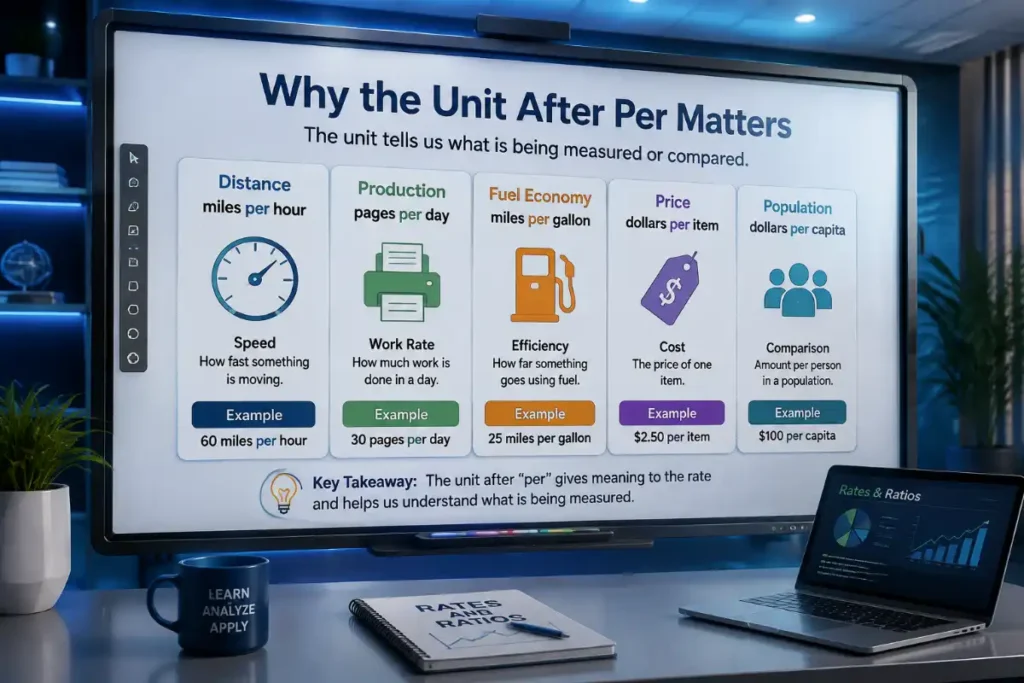
Consider these two expressions:
10 complaints per day
and:
10 complaints per month
The number “10” is the same, but the meaning is very different.
Likewise:
$50 per person
and:
$50 per group
describe very different pricing structures.
This is why readers should always pay attention to the unit that follows per.
Common Expressions With Per
| Expression | Meaning |
| per person | for each person |
| per hour | for each hour / hourly rate |
| per day | daily rate |
| per week | weekly rate |
| per month | monthly rate |
| per year | yearly rate |
| per annum | annually |
| per diem | daily/daily allowance |
| per capita | per person in a population |
| per serving | for each serving |
| per mile | for each mile |
| per unit | for each unit |
| per user | for each user |
| per second | for each second |
| per se | by or in itself |
Questions to Ask When Reading a Rate
Before interpreting any rate, ask:
- What quantity is being measured?
- What unit appears after per?
- Is the number an average or an exact value?
- What period does the measurement cover?
- Are the units consistent?
- Is the comparison fair?
- Does the rate include every relevant cost or condition?
These questions are especially important when reading statistics, prices, or performance data.
Common Mistakes When Interpreting Per
Mistake 1: Ignoring the Unit
A number without its comparison unit can be misleading.
For example:
100 sales
is different from:
100 sales per day.
Mistake 2: Treating an Average as an Exact Daily Number
If a website averages 1,000 visits per day, it does not necessarily receive exactly 1,000 visits every day.
Mistake 3: Comparing Different Units
Do not compare:
50 miles per gallon
with another measurement expressed using a completely different system without converting the units correctly.
Mistake 4: Assuming Per Capita Means Everyone Gets the Same Amount
A per-capita figure is an average across a population. Distribution can still be unequal.
Mistake 5: Confusing Per With Per Se
“Per se” is a separate phrase and does not describe a rate.
Frequently Asked Questions
What does per mean?
It most commonly means for each or for every when expressing a rate, price, quantity, or measurement.
Does per mean divide?
Not grammatically. However, many rate expressions can be represented mathematically by dividing one quantity by another.
What does per person mean?
It means for each person.
What does per hour mean?
It relates a quantity to one hour.
For example:
$20 per hour
means an hourly rate of $20.
What does per day mean?
It means for each day or at a daily rate.
What does per annum mean?
It means annually or per year.
What does per diem mean?
It refers to a daily basis and can also refer to a daily allowance or payment depending on context.
What does per capita mean?
It means for each person within a population.
What does per se mean?
It means approximately “by itself” or “in itself.”
What does per unit mean?
It means for each unit.
What does per serving mean?
It means the stated quantity applies to one defined serving.
Can you use per twice in one expression?
Yes.
For example:
$10 per user per month.
This means $10 for each user for each month.
Why are per rates useful?
They make it easier to compare quantities against a consistent unit rather than relying only on raw totals.
Is per useful in statistics?
Yes. Rates such as incidents per population, revenue per customer, or points per game can provide context that raw totals do not.
What is the easiest way to understand per?
Ask:
Per what?
The answer usually identifies the unit being used for comparison.