Ligament Injury Treatment: A Complete Guide to Recovery Options
Ligament injury treatment depends on which ligament is injured, how severe the tear is, whether the joint is clinically stable, whether other structures are damaged, and the person’s age, activity level, and functional goals. For many uncomplicated ligament sprains, initial management is conservative – protection, symptom control, and progressive rehabilitation. The specific approach still varies substantially by ligament and joint: an ACL tear, an MCL tear, and an ankle sprain are not managed the same way, even at similar severity grades.
What Actually Determines Treatment?
Clinicians weigh five factors before recommending a treatment path, and no single factor decides it alone.
- Which ligament is injured? Some ligaments, particularly the MCL and PCL, have a greater capacity for functional healing with conservative treatment than the ACL.
- Grade or extent of the injury – stretched, partially torn, or completely torn.
- Joint stability – whether the joint gives way during normal movement or specific clinical stress tests.
- Associated injuries – a torn meniscus, cartilage damage, or a second ligament injury changes the plan considerably.
- Patient age, activity level, and goals – a competitive athlete’s threshold for surgery differs from someone with lower physical demands.
Quick Answer: How Are Ligament Injuries Treated?
For many uncomplicated ligament sprains, treatment starts conservatively and is adjusted based on how the joint responds. Isolated MCL and PCL injuries are frequently managed nonoperatively at first, though some severe or complicated cases eventually need surgery. ACL tears are treated differently: when surgery is indicated, reconstruction is generally the preferred approach, though nonoperative management remains an option for selected, lower-demand patients.
- Read more: Ligament Injury Treatment
A Simple Decision Framework
Conservative treatment is more likely when the injury is isolated, the joint remains reasonably stable, symptoms are manageable, and activity demands are low to moderate. Surgical evaluation becomes more important when there is persistent instability, a combined multi-ligament injury, high sport-specific demands, or symptoms that don’t improve after a structured course of rehabilitation. These factors are commonly considered across ligament injuries, although the relative importance of each factor varies by ligament and joint.
Sprain vs. Partial Tear vs. Complete Tear
“Sprain” is the broad clinical term for any ligament injury – it does not specify severity. Within that term, injuries are graded:
- Grade 1: The ligament is stretched with microscopic fiber damage but remains intact. The joint stays stable.
- Grade 2: A partial tear. Some fibers are disrupted, causing mild-to-moderate looseness on stress testing.
- Grade 3: A complete rupture. The ligament no longer connects its two ends, and the joint may feel unstable.
Grading describes the extent of tissue damage, not automatically the required treatment.
How Doctors Diagnose a Ligament Injury
Diagnosis usually starts with a clinical exam, not imaging. A doctor or physiotherapist typically asks how the injury happened, checks the location of pain and swelling, assesses the range of motion, and performs joint-specific stability stress tests.
Imaging is added selectively:
- X-ray – ordered when a fracture is suspected, especially with an inability to bear weight or point tenderness over bone.
- MRI – used when a soft-tissue injury needs clearer characterization, when surgery is being considered, or when associated damage (meniscus, cartilage, another ligament) needs to be ruled out.
- Ultrasound – used by some clinicians for certain ligaments or for dynamic assessment, depending on the joint involved.
MRI is not required for every ligament sprain. Many grade 1 and grade 2 injuries are diagnosed and treated based on the physical exam alone.
Immediate Care After a Ligament Injury
The early priority is to protect the joint and manage symptoms, then reintroduce movement as soon as it’s tolerated. The early phase may involve activity modification, bracing, and – depending on the ligament and severity – temporary weight-bearing restrictions; there is no single universal timeframe that applies to every ligament injury.
Rest, ice, compression, and elevation remain a familiar first-aid framework for acute soft-tissue injuries. Contemporary rehabilitation thinking places greater emphasis on brief protection followed by progressive, symptom-guided loading rather than prolonged rest, and questions whether routine cryotherapy and anti-inflammatory use meaningfully improve long-term healing, even though both can still help manage short-term symptoms.
- Protection – brief activity modification, a brace, or crutches if weight-bearing is significantly painful.
- Compression and elevation – commonly used to help manage swelling.
- Ice – may provide short-term pain relief during the acute phase, though its effect on longer-term tissue healing is less clear; it’s best viewed as a symptom-management tool rather than a fixed protocol.
- Early, symptom-guided movement – a gentle range of motion is introduced once it can be done without significant pain, rather than being delayed for a set number of days.
Medication: Over-the-counter pain relievers may help manage symptoms, but the safest option depends on your medical history and other medications. Some contemporary rehabilitation approaches question routine anti-inflammatory use during the earliest phase of soft-tissue injury, since inflammation also contributes to tissue repair, although NSAIDs such as ibuprofen can still provide short-term pain relief and may be appropriate for some patients. Ask a clinician or pharmacist first if you have kidney, stomach, cardiovascular, bleeding, or medication-interaction risks. A corticosteroid injection is not a standard, generic treatment for a torn ligament and would only be considered by a doctor for specific clinical situations.
Non-Surgical Treatment
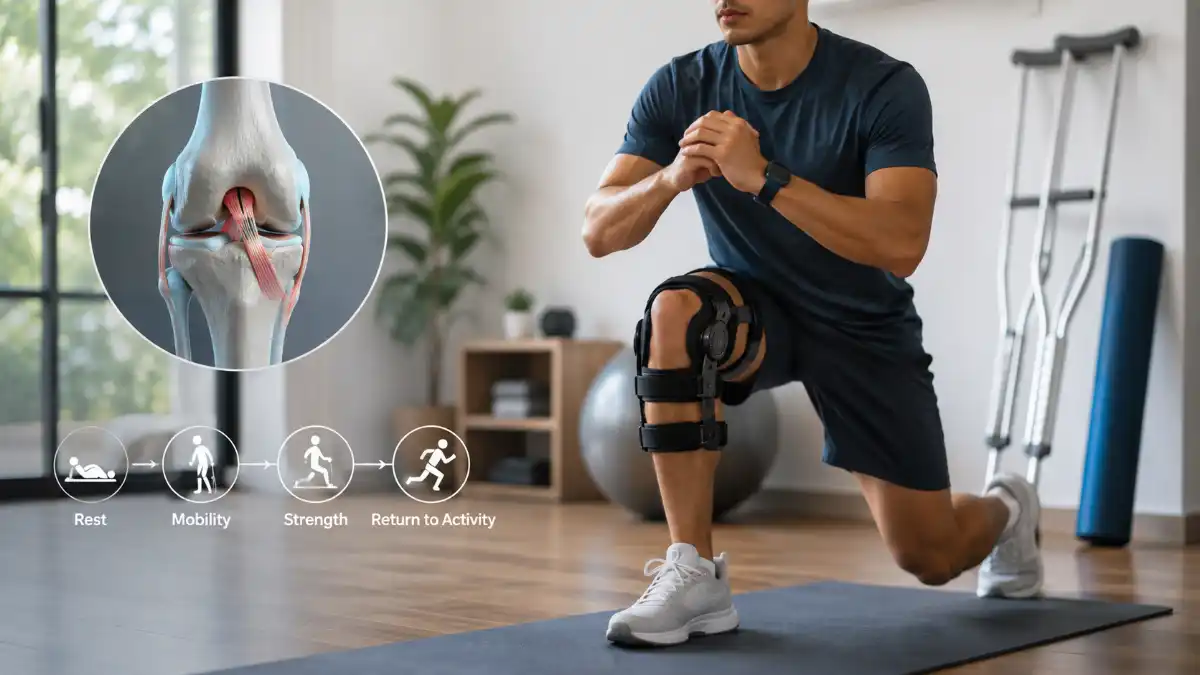
Non-surgical management is the primary starting point for most grade 1 and grade 2 ligament injuries, and for many isolated MCL and PCL injuries. A typical rehabilitation progression includes:
- Protection and symptom control – bracing and activity modification, with duration depending on the specific ligament and severity.
- Range of motion – restoring pain-free movement; some protocols temporarily restrict certain ranges of motion or loading to protect the healing ligament.
- Strengthening – targeting the muscles supporting the joint, such as early quadriceps activation in knee ligament injuries.
- Balance and proprioception – retraining the joint’s positional awareness.
- Neuromuscular and sport-specific training – drills matching the demands of the person’s sport or activity.
- Gradual return to activity – progressively increasing load and complexity, confirmed with functional testing rather than a fixed date.
A brace is typically used as a short-term bridge during early rehabilitation; using it indefinitely without progressing strength and control exercises can leave surrounding muscles weak and prolong recovery.
Ligament Injury Treatment by Joint
| Ligament/injury | Typical initial management | When surgery may be considered |
| Ankle sprain (ATFL/CFL), grades 1–2 | Brief protection, brace/taping, progressive loading, and rehab | Rarely considered for persistent instability after rehab |
| Severe ankle ligament sprain (grade 3) | Many can still be managed nonoperatively with bracing and structured rehabilitation | Persistent instability or associated injuries that don’t respond to rehab |
| ACL tear | Structured rehabilitation is an important component of both nonoperative management and recovery after reconstruction | Persistent instability, giving-way episodes, high-demand sport, or associated meniscus/cartilage injury; reconstruction is generally preferred over repair when surgery is indicated |
| MCL tear | Bracing and functional rehabilitation initially, for most grades | Selected severe grade III injuries, persistent instability, or specific structural injury patterns |
| PCL tear | Isolated grade 1–2 injuries are typically managed nonoperatively; selected isolated grade 3 injuries with limited symptoms may initially be managed nonoperatively.y | Persistent symptomatic instability, high-grade laxity, or a combined multi-ligament knee injury |
Many severe ankle sprains, including grade 3 injuries, can still be managed nonoperatively with bracing and structured rehabilitation, although persistent instability or associated injuries may change that plan.
For the ACL, when surgery is indicated for an acute isolated tear, clinical guidance from the American Academy of Orthopaedic Surgeons favors early reconstruction for patients who are candidates for surgery, because the risk of additional meniscal and cartilage injury begins to increase within roughly three months of injury; this guidance also generally favors reconstruction over repair due to lower revision rates.
For MCL injuries, most isolated cases are initially managed nonoperatively, but selected severe grade III injuries, persistent instability, or specific structural injury patterns may require surgical treatment.
For PCL injuries, selected isolated grade III tears may initially be managed nonoperatively, particularly when symptoms and functional limitations are limited, but persistent symptomatic instability or high-grade laxity may prompt surgical evaluation; combined PCL injuries involving other ligaments are a distinct clinical category managed differently.
When Surgery Is Considered
A complete ligament tear does not automatically require surgery. Whether surgery is recommended depends on the specific ligament, degree of instability, associated injuries, activity demands, and how the joint responds to an initial period of rehabilitation.
When surgery is indicated, there are two general approaches:
- Repair – reattaching the ligament’s original tissue, generally an option only when that tissue is in acute, good-quality condition.
- Reconstruction – replacing the ligament with a graft, taken either from the patient’s own tissue or from a donor. For ACL surgery specifically, current orthopedic guidance favors reconstruction over repair, citing lower revision rates.
Post-surgical rehabilitation follows a structured protocol similar to nonoperative rehab but generally starts more conservatively to protect the graft, gradually advancing weight-bearing, range of motion, and strengthening over several months.
Recovery Patterns and Return-to-Activity Criteria
Recovery is not measured by a calendar date alone. The following ranges are broad patterns, not individual predictions.
| Injury | Typical recovery pattern |
| Mild ankle sprain | Often improves noticeably over a few weeks; continued rehabilitation may extend longer |
| Grade 1 MCL | May allow a relatively rapid return to activity |
| Grade 2–3 MCL | Generally requires longer rehabilitation and functional testing before return to sport |
| Isolated PCL (nonoperative) | Bracing commonly continues for several weeks to a few months, with return to sport guided by strength and stability testing |
| ACL reconstruction | Rehabilitation commonly spans many months before return to competitive sport.t |
Return to competitive sport after ACL reconstruction commonly takes many months and should be based on strength, movement quality, joint stability, psychological readiness, and sport-specific functional testing rather than a fixed calendar date. This same principle – function over time-since-injury – applies across all ligament injuries: clinicians look for pain and swelling under control, full or near-full range of motion, joint stability, strength comparable to the uninjured side, restored balance, and confidence performing sport-specific movements.
When Does a Ligament Injury Need Medical Attention?
Seek urgent evaluation for:
- Visible joint deformity
- Inability to bear any weight after a significant injury
- Severe or rapidly increasing swelling
- Numbness, tingling, or loss of circulation below the injury
- Suspected fracture or dislocation
- Major instability or a joint that feels like it’s about to give way
- High-energy trauma (a fall from height, a vehicle collision)
Arrange a routine evaluation if:
- Pain isn’t improving after several days of appropriate care
- Swelling persists beyond what seems typical for the injury
- The joint repeatedly gives way during normal activity
- Every day movement remains difficult beyond the expected initial recovery window
- Symptoms return whenever the activity level increases
Common Mistakes That Slow Recovery
- Resting completely for too long instead of progressing to symptom-guided loading once acute pain settles.
- Returning to sport based on pain relief alone, without confirming strength and stability
- Insufficient rehabilitation, including inadequate strength and balance training, can increase the risk of recurrent sprains.ns
- Wearing a brace indefinitely instead of using it as a short-term bridge to rehabilitation
- Assuming an MRI is necessary for every sprain when a physical exam is often sufficient
Frequently Asked Questions
How long does a ligament injury take to heal?
Timelines vary by ligament and grade. Mild ankle sprains often improve within a few weeks; grade 1 MCL injuries may allow relatively rapid return to activity, while grade 2–3 injuries take longer. ACL reconstruction rehabilitation commonly spans many months and is confirmed with functional testing rather than a fixed date.
Can a torn ligament heal without surgery?
Often, yes, for the MCL and PCL – many isolated tears, including some complete ones, respond to bracing and rehabilitation, though severe or complicated cases may still need surgery. The ACL is different: it has limited capacity for functional healing on its own, so reconstruction is commonly recommended for active or high-demand patients.
How do I know if a ligament is torn?
Signs include a “popping” sensation at the time of injury, rapid swelling, bruising, and joint looseness. Confirming the diagnosis requires a clinical exam with stability testing and sometimes imaging.
Can you walk on a torn ligament?
Mild sprains often still allow limited walking. Complete tears in weight-bearing joints like the knee or ankle more often cause instability that makes walking difficult without support until the joint is properly protected.
When does a ligament injury need surgery?
Generally, when there’s persistent instability that doesn’t improve with rehabilitation, associated meniscus or cartilage damage, or a combined multi-ligament injury. This threshold differs by ligament – it’s reached more often with the ACL than with the MCL or PCL.
What’s the difference between a sprain and a tear?
“Sprain” covers the full spectrum of ligament injury, from stretching to complete rupture. “Tear” specifically describes partial or complete fiber disruption within that spectrum.
How do you know when you’re ready to return to sport?
Readiness is based on function – strength, balance, joint stability, and confidence in sport-specific movements – confirmed through structured testing, not simply how much time has passed since the injury.
What’s the fastest way to reduce swelling after a ligament injury?
Elevating the joint above heart level, applying compression with an elastic bandage, and using short intervals of ice in the first few days tend to help most with early swelling. Avoiding activities that keep re-aggravating the joint matters just as much as any single technique, since repeated strain delays swelling reduction regardless of how consistently ice or compression is applied.
Can ligaments be strengthened to prevent future injuries?
Ligaments themselves have limited ability to be directly strengthened through exercise, but the muscles, tendons, and neuromuscular control surrounding a joint can be trained to reduce strain on the ligament and lower re-injury risk. Balance work, sport-specific strength training, and proprioceptive drills are the main tools used for this, particularly after a first sprain, when the risk of a repeat injury in the same joint is highest.
Is swelling always a sign of a serious ligament injury?
Not necessarily. Swelling reflects the body’s inflammatory response to tissue damage and can occur with mild sprains as well as severe tears. The amount of swelling alone doesn’t reliably indicate severity – joint instability, ability to bear weight, and results of a clinical stability exam are better indicators of how serious the injury actually is.
Do ligament injuries increase the risk of arthritis later in life?
Some ligament injuries, particularly untreated or repeatedly re-injured ones affecting weight-bearing joints like the knee, are associated with a higher long-term risk of joint changes consistent with early osteoarthritis. This risk appears to be influenced by associated cartilage or meniscus damage at the time of injury as much as by the ligament tear itself, which is part of why addressing associated injuries matters, not just the ligament in isolation.